In the history of fractal art, we examine some of the names mathematicians and artists have chosen to call their fractals, discovering how these names originated and what they signify.
Examples of Fractals in Classical Art
The human mind has an affinity with fractals. Our natural surroundings are filled with these intricate and beautiful structures, and we have evolved with an instinctive ability to process visual information characterized by their forms.
Consider the patterns found in the branching of trees, the tributaries of a river, or the peaks and valleys of a mountain. These fractal shapes have always existed around us, and our understanding of them has helped us thrive in the natural world.
Fractals have been seen by many as portraying what is harmonious and beautiful in nature, and, not surprisingly, they have appeared in various art forms over the ages as artists have tried to express nature's intrinsic beauty.
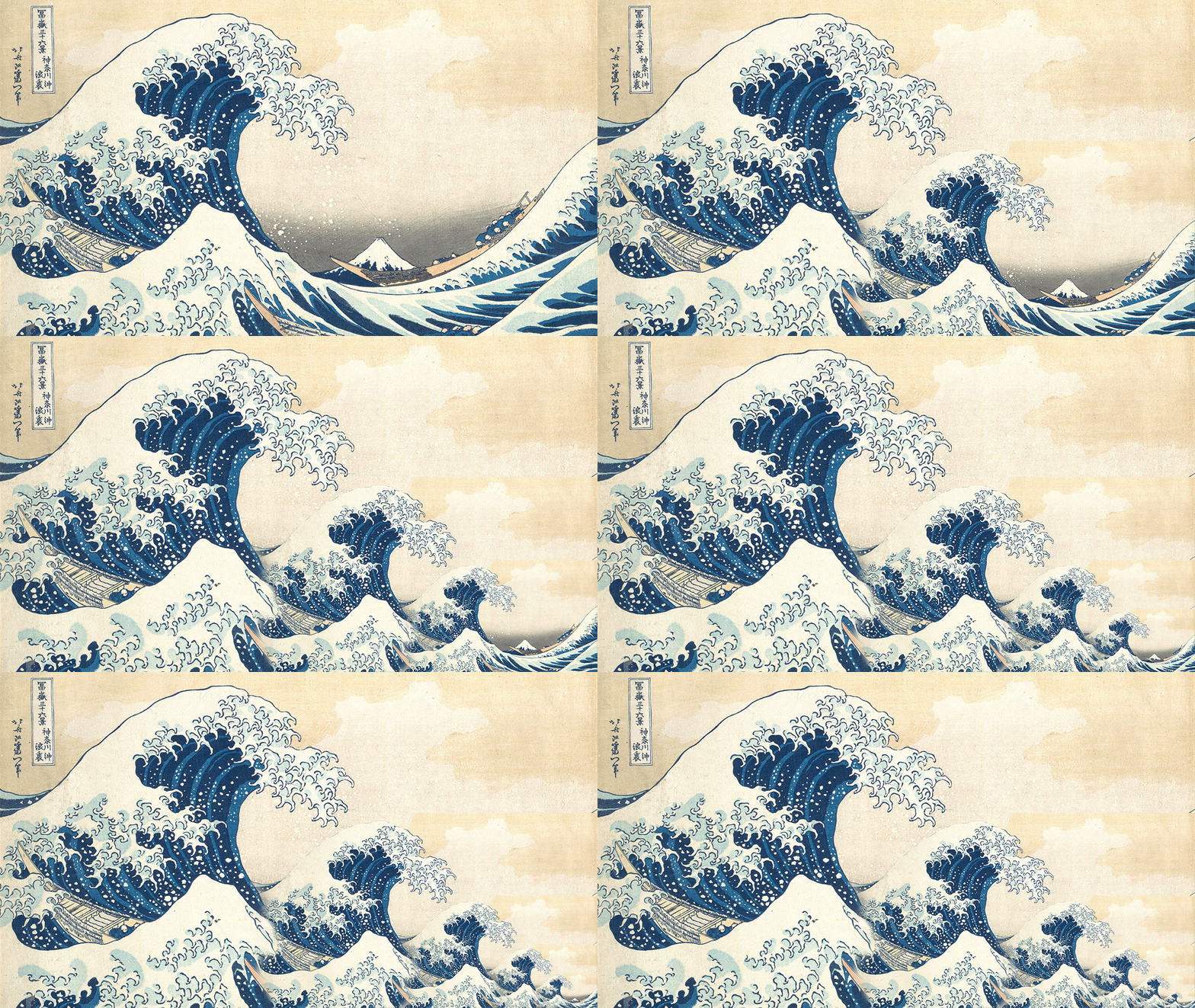
Take, for example, the Japanese woodblock print "The Great Wave off Kanagawa" by Hokusai. [1]. In this artwork, he employed a fractal shape to portray a wave, where smaller waves nestle within the larger one, mirroring each other at different scales. This aligns closely with the principles of fractal geometry.
While Hokusai may not have consciously aimed to create a fractal, his keen observation of natural forms led him to depict the fractal shapes that waves exhibit.
The Great Wave off Kanagawa by Hokusai was created 1831 and contains the repeating, self-similar patterns found in fractals, a mathematical concept that was not formally described until centuries after the artwork's creation.
Historic Names of Fractals From the Early 20th Century
Just as artists have recognized fractal patterns in nature, scientists have also observed natural forms in mathematical fractals that resemble familiar objects in the real world.
As mathematicians recorded their fractals in mathematical journals, they often named them after objects they resembled for easier recognition and description.
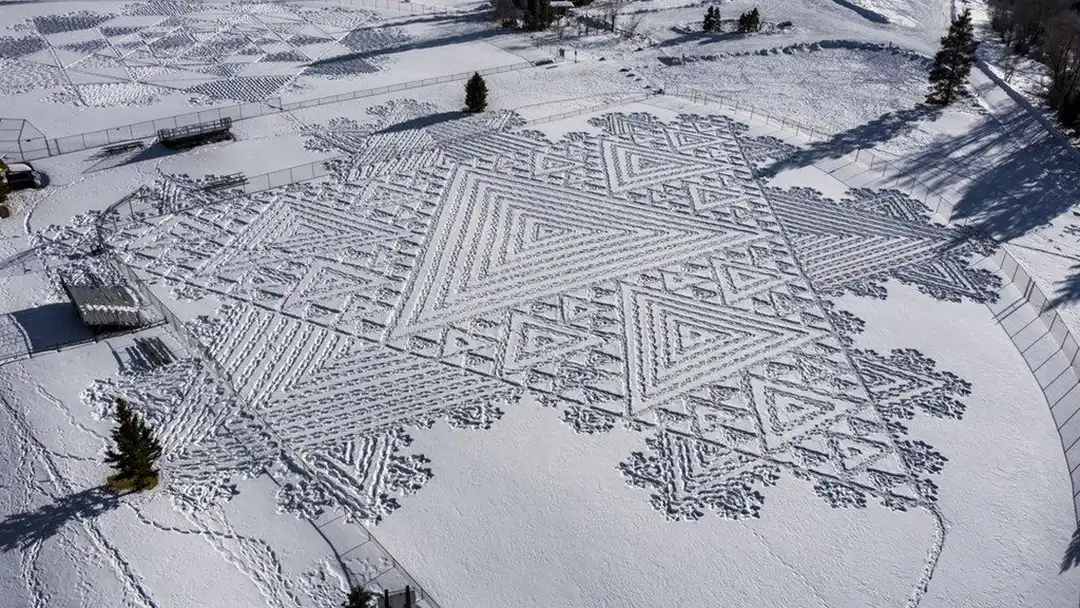
One notable example is the Koch snowflake, a fractal shape introduced in 1904. It first appeared in a paper titled "On a Continuous Curve Without Tangents, Constructible from Elementary Geometry," written by Swedish mathematician Helge von Koch.[2]
A Koch Snowflake created by the Artist Simon Beck. These large-scale, geometric fractal made in the snow are created by walking in snowshoes across snowfields, using a compass and a rope to measure and create intricate patterns.The imaginatively named Dragon curve fractal, composed of an infinite union of geometrically similar components. It was first described by Martin Gardner in his *Scientific American* column "Mathematical Games" in 1967. [3]
Where the name Fractal came from
With advancements in computer technology during the 1970s and 1980s, computer scientists began to generate fractals with ever-increasing complexity as they explored them with the power of modern technology. During this time, an increasingly sophisticated language developed to articulate and share their findings.
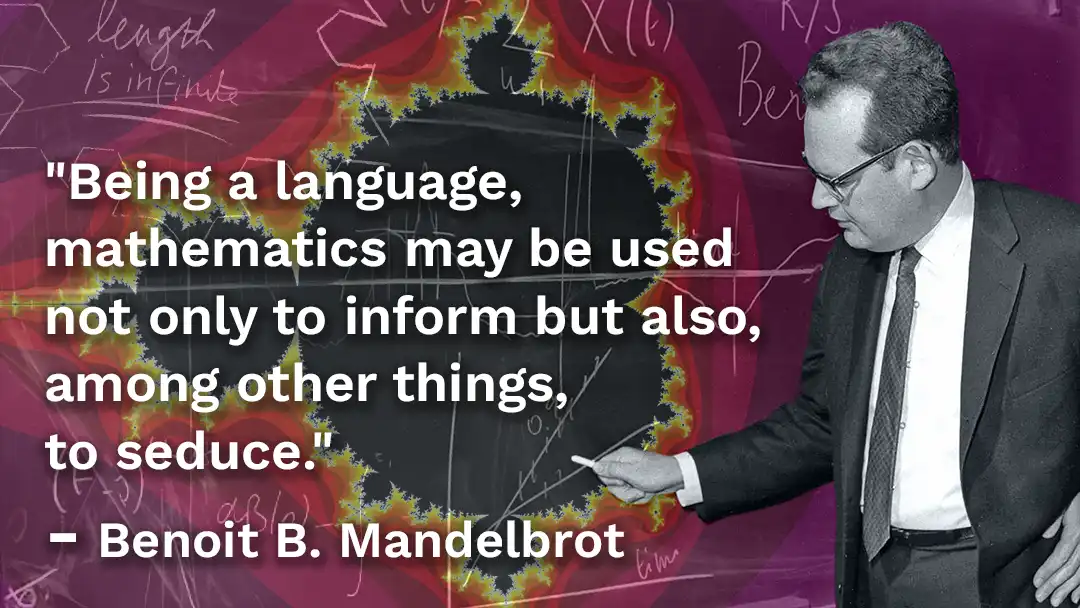
The term "fractal" was coined in 1975 by Benoit Mandelbrot, based on the Latin word "fractus," meaning "broken" or "fractured." He used this term to draw parallels between fractals and real-world structures.
In his seminal book The Fractal Geometry of Nature[4], Mandelbrot also introduced the term "island" to describe features of the Mandelbrot set, conjuring up images of exotic archipelagos waiting to be explored.
Several geographic terms have entered common usage when describing fractals. The area at the center of the Mandelbrot set, often depicted in black, is frequently referred to as the "main continent."
Where this connects to smaller continents, the narrow regions that protrude are often referred to as "valleys".
These valleys are often divided along lines of symmetry known as the eastern and western sides of the valley.
As new shapes and structures emerged within the details, these sparked people's imaginations, and colorful names were given to individual valleys to help describe them. Names such as "seahorse valley" and "elephant valley" emerged and became common parlance that is still used today.
Benoit Mandelbrot, the 'father of fractals' who coined the word Fractal based on the Latin word "fractus," meaning "broken" or "fractured.
What is Seahorse Valley, and where is it on the Mandelbrot set?
Seahorse valley commonly refers to a specific area found in the Mandelbrot set in the valley between the largest and second-largest continents.
This area, when magnified, reveals a series of curves that resemble the head and body of seahorses, hence its name. It is often featured as it has some of the most elegant structures of the Mandelbrot set, containing double spiral arms and an abundance of smaller Mandelbrot sets.
To find some of the early examples of its use, you can go back to the art exhibition Frontiers of Chaos[5], which showcased computer-generated fractal art to the public in 1985. This exhibition toured internationally under the auspices of the Goethe Institute, first in Europe and then in America.
Later in the book The Beauty of Fractals, published to accompany the exhibition, the name is used frequently to describe this area of the Mandelbrot set.[6]
How Seahorse Valley Became Common Parlance in Fractal art
During the late 1980s, interest in fractals and the emerging scientific field of Chaos Theory spread to a wider audience. Software applications such as Fractint allowed users to generate their own fractals on home computers.
As artists began to experiment with this new medium, many of the popular books that showcased fractal images used the term Seahorse Valley. In August 1985, Scientific American [7],featured images of this specific region of the Mandelbrot set in a cover article introducing fractals to a broad audience, cementing this term into common use.
Seahorse valley is now the accepted term for this area of the Mandelbrot fractal and is mentioned on the Wikipedia page several times.
Elephant Valley is the name of an area of the Mandelbrot fractal. It is located along the large single point inside the main continent. It is commonly called Elephant Valley because its magnified details resemble a procession of elephants marching head to tail into infinity.
Common Names Used in Fractal Art
It has been well understood by abstract artists that giving a work of art a title that strongly ties it to something familiar can influence how the audience interprets it and make it more accessible. When it comes to the naming of a fractal image, artists have only been limited by their imagination. Like many contemporary artists, they frequently use titles that range from the descriptive to the abstract.
There are, however, some common themes for the names of fractal art, and those can be grouped together.
Fractals named after natural forces
Common names artists have chosen for their fractal art often invoke a sense of awe and wonder at how fractals mirror the forces of nature, especially elemental forces that appear chaotic and beyond our control. Lightning, storm clouds, whirlwinds, earthquakes, crashing waves on a coastline, flames, and plasma are recurring themes.
Elemental shapes have always been hard to describe using the classical language of geometry, such as circles, squares, and triangles. Fractals, however, naturally depict these chaotic patterns, and the names chosen often highlight their strong visual and structural resemblance.
Fractals with spiritual names
The cosmic, magical, and spiritual nature of fractals has often conjured up mystical names that have been used to describe them. The new age thinking of the Chaos theory popularized in the early 90s set a generation of fractal artists on a course with a new sense of awakening and the feeling of encountering something profound.
The infinite nature and repeating patterns resonated with ancient symbols of worship as being of a divine order.
Angels, Dragons, Talisman, Mandalas, and Themes of Sacred geometry often appear in the titles of fractal art, tying their themes to ancient worship.
Psychedelic names used for fractals
Fractals have often been adopted by psychedelic artists as the tie-dye of the computer age. Fractals can appear to be psychedelic, as the kaleidoscopic patterns, vivid colours and repeating self-similar mirror the visual effects produced by psychedelic drugs.
In the early 90s, fractal art frequently featured in dance music videos on the flyers for all-night raves. People would adorn their walls with colorful poster art and leaflets.
Names such as Kelidoscope, trippy, mushrooms, peace, love, and dreams have been used to market art to a hedonistic subculture.
Cosmic and planetary names for fractals
Many artists have named their fractal creations after cosmic phenomena, such as spiral galaxies, planetary orbits, nebulae, and other large-scale structures of the cosmos.
Many scientific images of space exhibit patterns that are reminiscent of fractal geometry, and artists have drawn inspiration from these visual similarities to describe their work.
By using "cosmos" in the name, artists can evoke the vastness and complexity of space, which mirrors the intricate, infinitely complex nature of the fractal images they create.
Many of the popular fractal programs produced 3D renderings of fractals, and artist found themselves creating otherworldly landscapes and naming their images after the worlds they created.
Conclusion
Artists often find themselves drawn to fractals as their shapes and patterns represent natural balance and harmony. Nature is adept at solving problems using fractals, often as a result of simple, recursive processes, like a branching structure found in plants or a river carving its path.
The similarity of natural forms is often reflected in the names of fractal art, and common themes can include branches, trees, flowers, horizons, ripples, lakes and sunsets. Animal forms also feature, such as owls, seahorses, and butterflies.
The Names of Fractals Now and in the Future
At the peak of discovery in the 80s and 90s, a whole language grew in an attempt to classify the Mandelbrot set and other fractals, and, in some ways, has come and gone.
Like many languages that are no longer commonly spoken it is true that new words will emerge in the future to replace them; however, these familiar, often colloquial terms stand as a record of this time. They affect our ways of seeing and talking about fractals, and echoes of them are likely to persist long into the future.
Science and art are always evolving, and with fractal art, this often happens together. As new understanding and technologies arrive, so too will new names and ways to describe them.
 Fractal Artist