Facebook Instagram
Tim WatersFractal Artist

Fibonacci Fractal Flowers

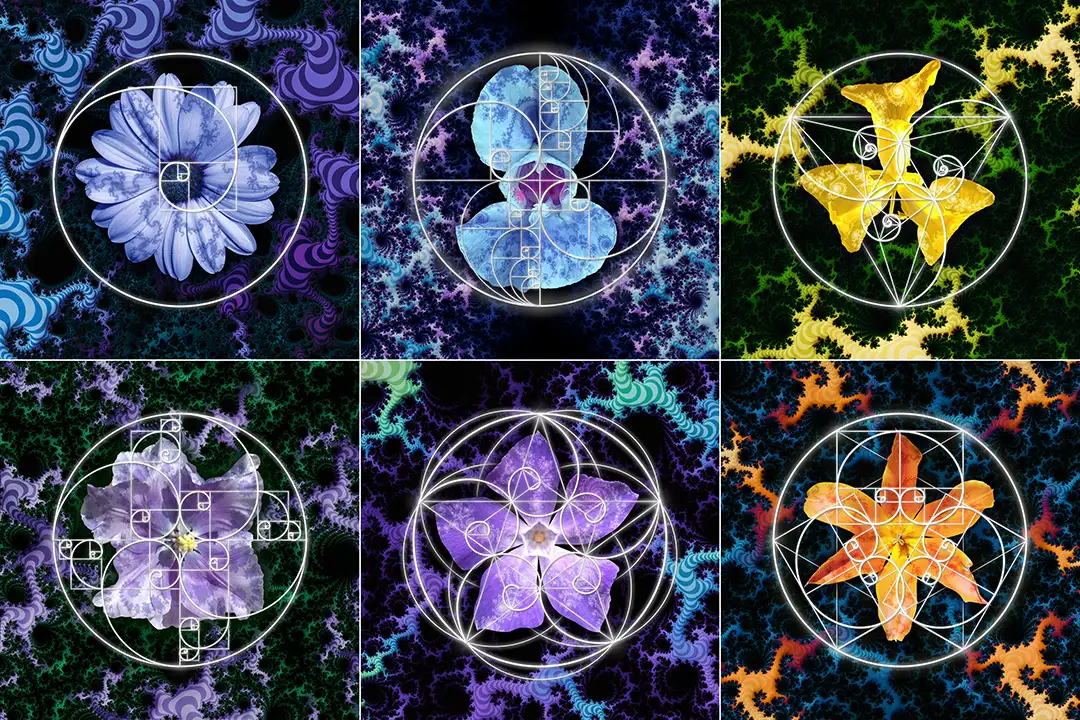
I created this artwork to combine my interests in nature and mathematical patterns. By layering photography, line-drawn shapes, and computer-generated fractals, I aimed to explore the world around me and inspire new understandings.

The photos feature flowers that exhibit distinct mathematical symmetries and similarities across different scales I am endlessly fascinated by these shapes, and fortunately, nature rewards me with an infinite variety. I treasure these discoveries, and these photographs serve as my mementoes.

The backgrounds are computer-generated fractals. I steal the colours from the photographs of the flowers and apply them to the fractals to give them structure. I also find parts of the fractal that have areas of symmetry that echo the flowers. Although the fractals are purely mathematical, the similarities remind me that mathematics is not a human invention; it is a fundamental part of nature, just as we are part of it.

The line drawings represent the Fibonacci sequence, which is a fractal structure in itself. I have transformed these into sacred geometry symbols that represent the reverence I have for the mystery of mathematics, art, and nature.

I hope by combining these layers together, I connect the natural and man-made world I live in, letting me see both in a new light, one from the perspective pf the other and letting me feel like I am experiencing a part of a whole.

The fractals were generated using software I have developed. It's a web application for mobile and desktop, and is free to use.


The photographs were taken on my phone on visits to the RHS Gardens in Manchester and the Marie Louise Gardens, a tree park in my local area.

I draw the sacred geometry symbols in Photoshop and then blend these layers together to create these unique designs.

Fractal Flowers


Wall Art Available In Our Store

More about the computer-generated fractals

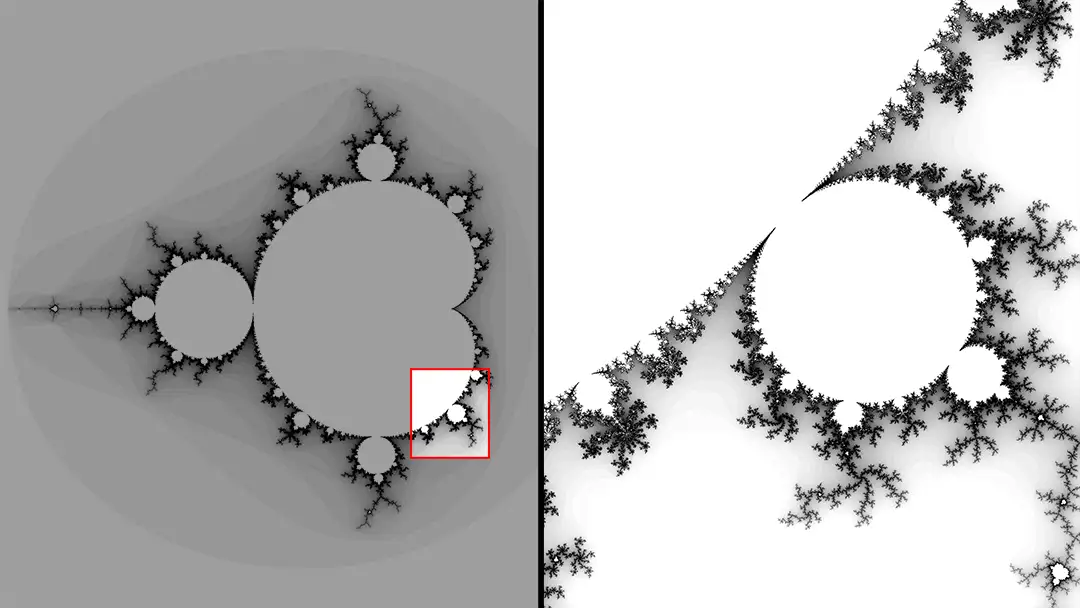
The computer-generated fractals used in the background were taken from an area of the Mandelbrot set around the period 4 bulb of the main cardioid. They are from the boundary of the 4th bulb or the valley at its entrance. This area has stubby, bifurcating branches that have a more shrubby look. Each image is from an area that has a strong radial symmetry from 1 through to 6 that matches the symmetry of the flowers.

They were generated using my own software, which allows me to zoom in and frame an area as well as apply a colour palette or alternate colour palettes to create the stripes. A colour image is created as well as a grey scale image used as a height map, which are then imported into the 3D rendering application Blender. My fractal app also generates the steps to create a zooming effect used in the animated version.

The fractal app is made using JavaScript (React). The latest version is available on my website and is free to use. It runs in a web browser and is also designed to work on a mobile device.

Sacred Geometry FAQ

Question: What is the Fibonacci pattern in flowers?

Answer: The number of petals in many flowers often corresponds to a Fibonacci number, which is part of a fractal pattern a sequence where each number is the sum of the two preceding ones (1, 1, 2, 3, 5, 8, 13, 21...).

Question: What are the Fibonacci patterns in flowers?

Answer: Many plants display petal counts that are Fibonacci numbers: buttercups have 5 petals, lilies and irises have 3 petals, corn marigolds have 13 petals, some asters have 21 petals, while daisies can have 34, 55, or even 89 petals.

Question: What is the sacred geometry of flowers?

Answer: On a deeper metaphysical level, the intricate structure of flowers is often linked to sacred geometry the patterns and shapes that underlie all of creation. The spiral shapes of many flowers are reflections of the Fibonacci sequence, a mathematical ratio that appears throughout nature.

Question: How is the Golden Ratio incorporated into sacred geometry and what does it represent?

Answer: In sacred geometry, the Golden Ratio is regarded as a fundamental building block that represents a divine proportion, symbolizing harmony, beauty, and balance within the universe.

Question: What is radial symmetry in flowers?

Answer: Many flowers exhibit radial symmetry, where their parts radiate outward from a central point. Many natural formations display spirals that often align with the Fibonacci sequence and the golden spiral.

Question: What is the pattern of a sunflower called?

Answer: The pattern found in sunflower seeds is known as 'phyllotaxis', which originates from the Greek words for 'leaf' and 'arrangement.' This pattern is also visible in other natural forms, such as pine cones and pineapples. Spiral phyllotaxis uses an angle of 137.5 degrees to position each new seed formed.

Question: What does the term sacred geometry in flowers mean?

Answer: The term "sacred geometry in flowers" refers to the study of how floral patterns and shapes reflect mathematical principles and natural design. Sacred geometry explores the geometric shapes and patterns that appear in nature, believed to be fundamental to the structure of the universe.